Decorative ironwork in the wrought iron tradition — gates, railings, scrollwork and heritage-matched pieces, designed and fabricated in our Leeds workshop. Coded welders. Free site survey. Written quote in three working days.
Walk past a Victorian terrace with the original ironwork still in place and you can see why it was made the way it was. The railings are slim, the finials line up, the scrollwork has the slight asymmetry that hand-bending always carries. Then look at the gap where one panel has been replaced — usually with a powder-coated bar-and-box panel from a builder's merchant, two decades younger than its neighbours and visibly wrong. The proportions are off, the spacing's modern, and the eye picks it up immediately even when the casual passer-by can't say why.
That mismatch is the brief most homeowners bring us for wrought iron work. A pair of gates that match the railings already there. A new boundary that suits a Georgian frontage. A scroll panel to fill a gap where a section has rusted out. A balcony rail in the same family of details as the gable trim, fifteen feet away on the same façade. The job isn't to make something dramatic — it's to make something that looks like it has always been there.
And there's an honest distinction to draw before we start. True wrought iron — the puddled, fibrous, low-carbon material rolled from raw bloom — has not been commercially produced in the UK since the 1970s. What every working "wrought iron specialist" in the country actually fabricates today is decorative mild steel, shaped and finished in the wrought iron tradition. The look is indistinguishable to the eye; the metal underneath is different. We say so up front because some specialists don't, and you should know what you're buying.
Decorative ironwork in the wrought iron tradition — gates, railings, scrollwork panels, garden features and heritage matching, fabricated in mild steel using traditional forming techniques. Every commission is sized and detailed to your specific property; we work from photographs, sketches, salvaged sections or the original drawings if you have them.
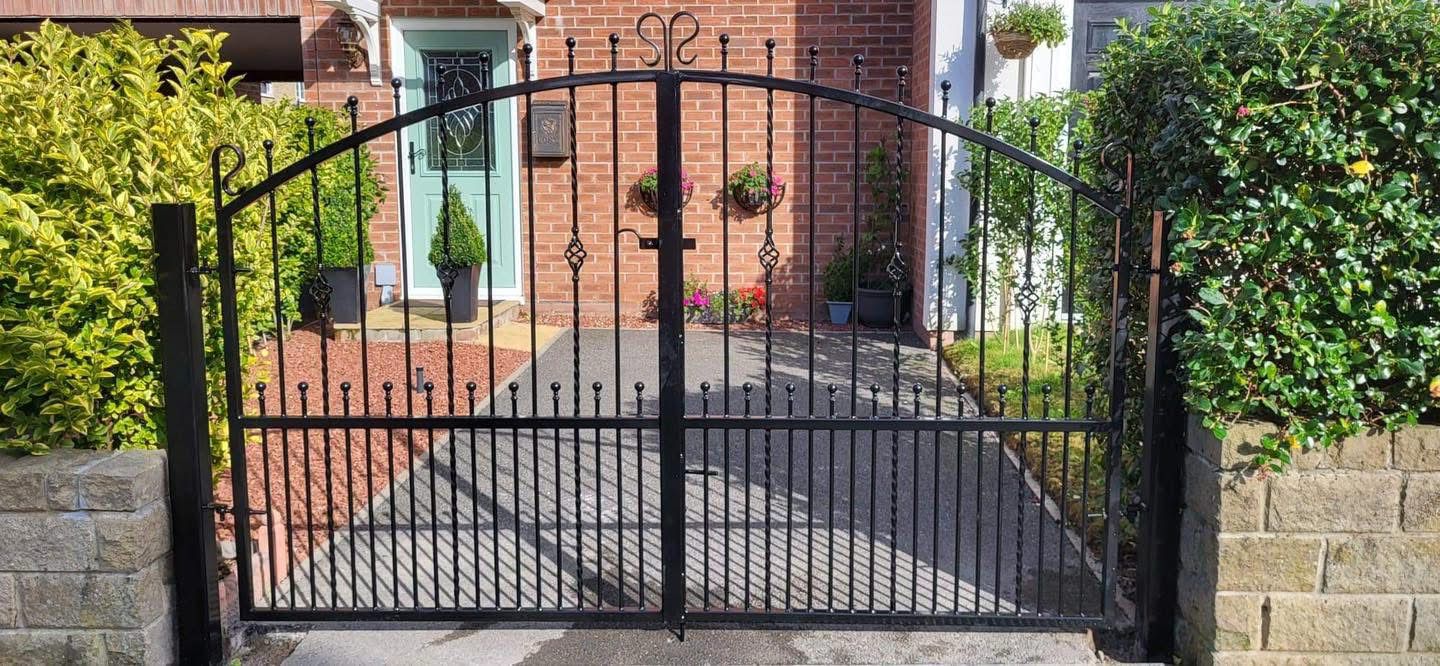
Single and double driveway gates with scrollwork, finials, and decorative top rails. Pedestrian gates for side paths and rear gardens, in matching designs. We hold a small library of traditional motif drawings — scrolls, leaves, basket twists, fleur-de-lys finials, ring details — and bring them together to suit your property rather than pick from a catalogue. Galvanised and powder-coated for British weather, or paint-finished in heritage colours where conservation guidance applies.
Front-of-house railings, boundary railings, dwarf walls capped with ornamental ironwork, and stair railings inside or out. Vertical bar runs with cast-effect finials. Scroll-infill panels. Spear-top boundary railings to match neighbouring Victorian and Edwardian terraces. Heights and spacings are set to suit the property and any conservation-area guidance; we'll flag listed-building or Article 4 considerations on the site survey rather than after the work starts.
Standalone scrollwork panels for gable details, balcony infills, gate centres, gable apex pieces and architectural feature work. Scrolls formed on traditional scroll jigs and mandrels, heated in a gas forge where the geometry demands it, and assembled with collared or welded joints depending on the finish required.
Replication of damaged or missing sections to match an original design. Send us photographs of the surviving ironwork, or we'll visit site to measure, sketch and document the details. We replicate scrolls, finials, rosettes and section profiles to sit alongside the original work, finished to weather in. For listed buildings or conservation areas we'll work with your heritage consultant or local authority conservation officer on materials and finish.
Arches, pergola frames, plant supports, garden screens, obelisks and rose arbours. Functional pieces with a decorative edge, fabricated to last outdoors in a British garden and finished to your colour preference.
We work primarily in mild steel — readily available, easy to forge, weldable, and the right substrate for the traditional aesthetic. Bar sections from 10mm round for delicate scrollwork through to 25mm square for structural elements. Finishes are wire-brush primer and traditional paint, hot-dip galvanising plus powder coat for the longest external life, or wax-finish for interior pieces where a more natural patina is wanted. Stainless steel is available where corrosion exposure is exceptional, though it changes the aesthetic.
Standards: Welded by coded operatives certified to BS EN ISO 9606. Fabrication tested to BS 4872. Heritage and conservation work delivered in coordination with your conservation officer or heritage consultant as required.


An honest note on materials. The phrase "wrought iron" describes a tradition as much as a metal. True puddled wrought iron stopped being commercially produced in Britain in the 1970s; everything sold as wrought iron today is decorative mild steel made the old way. We use it because it's the right substrate — weldable, forgeable, and structurally appropriate for the work. If you have salvaged original wrought iron and want it restored rather than replicated, tell us at survey and we'll talk you through what's possible.
Send photos of the property, the existing ironwork (if any), and the opening or run we'll be working with. Sketches and Pinterest references welcome.
Free and no obligation. We measure on site, document existing details, and discuss heritage or conservation constraints if any apply.
Scaled drawings and a written, itemised quote — typically inside three working days. Revisions handled before any metalwork begins.
Built in our Leeds workshop by coded welders. Scrollwork formed by hand on jigs and mandrels. Photos sent at key stages.
Fitted by the same team that built it. Post foundations, alignment with existing ironwork, finish touch-up after install — handed over clean.
We tell you the difference between true wrought iron and decorative mild steel before we quote. No marketing claims you'd have to unpick later.
Scrolls, finials and spacings drawn to suit your property — replicating what's there, not the nearest stock pattern from a parts list.
Fabricators certified to BS EN ISO 9606. Welding tickets available on request — we'll happily share them.
From the first sketch to the last touch-up, you're talking to the same workshop. No subcontracted install, no shipped-in panels pretending to be bespoke.
Rooted in West Yorkshire, working nationally. Our workshop is in Leeds. We fit ornamental ironwork routinely across the wider Yorkshire region for residential projects; for larger heritage commissions we deliver and install across the UK where the project warrants the travel.
Not in West Yorkshire? Get in touch — we travel for the right heritage project.
Honest answer: it's decorative mild steel fabricated in the wrought iron tradition. True puddled wrought iron stopped being commercially produced in the UK in the 1970s, so every modern wrought iron specialist works in mild steel using traditional forming and finishing techniques. The visual result is indistinguishable; the substrate underneath is different. We tell you up front because some specialists don't.
Yes, this is one of the most common things we're asked for. Send us photographs, or we'll visit site to measure and document the surviving details — scroll geometry, finial profile, spacing, bar section. We replicate to match the original, finish to weather in, and install so the new and old sit together without an obvious join.
Yes — with the right finish. For external work we typically recommend hot-dip galvanising plus a powder-coated or paint top coat. That gives the longest service life with the lowest maintenance burden. Traditional paint-only finishes are available where conservation guidance requires it, but plan for a touch-up cycle every few years.
Possibly. Listed buildings, conservation areas, and Article 4 zones often have additional rules on materials and finishes. We're not planning consultants, but we'll flag anything obvious on the site survey and point you to your local authority conservation officer. Heritage-sensitive projects benefit from involving them early.
It depends on scale and complexity. A pair of ornamental gates is typically three to four weeks from design approval to installation. A larger commission with multiple panels, scrollwork replication and heritage-sensitive finishing can run four to eight weeks. Every quote includes a target install date.
With a conversation. Photos of the property, sketches, reference images, salvaged sections — anything is useful. We follow up with a free site survey, then scaled drawings for your approval before any metalwork begins.
It varies with size, design complexity, scroll content and finish. A simple pedestrian gate sits in the low hundreds; a pair of large ornamental driveway gates with finials and matching pedestrian gate can run into the low thousands. Every quote is written, itemised and subject to specification and site survey.
Bespoke ornamental driveway gates with traditional scrollwork and matching pedestrian gate, hot-dip galvanised and finished in black powder coat.
Survey to handover: 4 weeks
Ornamental stair railings for a heritage entrance, designed to sit alongside the property's existing period detail. Scrollwork formed by hand on traditional jigs.
Heritage-matched design
Decorative stair railings with scroll-detail centre panels. Designed to complement an existing balustrade run elsewhere in the property.
Traditional paint finish
More residential work on the Projects page.
Send photos of your property and any reference styles. We'll come back with a written quote inside three working days — site survey free, no obligation. All quotes are subject to specification and site survey.
Or message us on WhatsApp